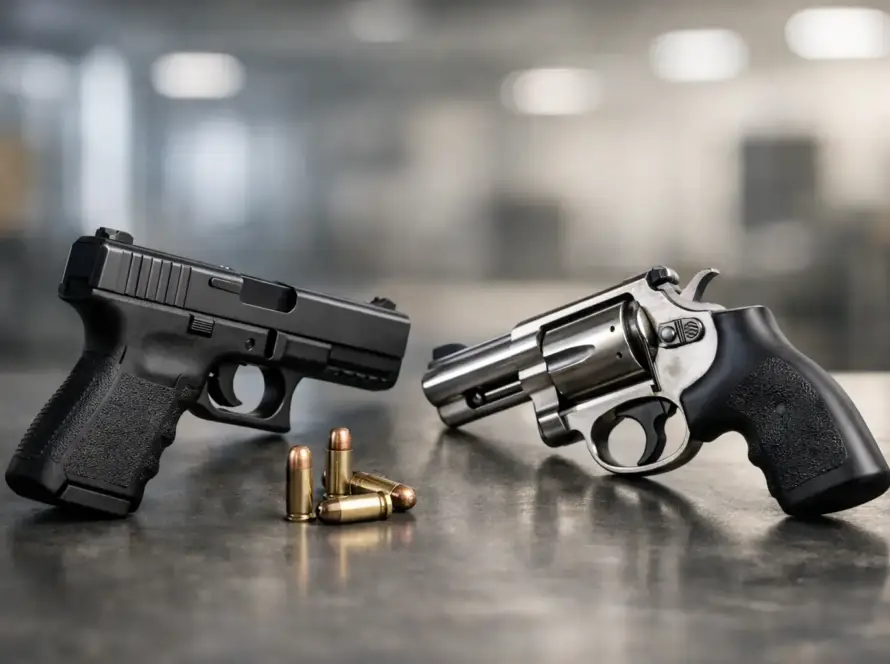
When someone asks for the most reliable handgun for self defense, the real answer is usually narrower than they expect. Reliability is not just about brand reputation or price. It is about whether a specific pistol runs with your carry ammo, fits your hand, can be shot well under stress, and holds up to regular use without drama.
That is why the best choice is rarely the flashiest gun in the case. For serious self-defense use, proven striker-fired 9mm pistols from established makers still set the standard. Models like the Glock 19, Glock 17, SIG Sauer P365 series, Smith & Wesson M&P 2.0 line, Springfield Armory Hellcat Pro, and CZ P-10 series keep coming up for one reason – they have strong track records, broad holster and magazine support, and parts availability that matters if you actually train.
What makes a handgun reliable for self defense
A reliable defensive handgun has to do the same thing every time. It has to feed, fire, extract, and eject with defensive ammo, not just cheap range ball. It also needs magazines that work consistently, sights that stay put, and a design that does not become maintenance-sensitive after a few hundred rounds.
That last point gets overlooked. A pistol can feel great in the hand and still be the wrong pick if it starts choking when it gets dirty, runs poorly with hollow points, or depends on one hard-to-find magazine that may or may not be in spec.
Reliability also includes practical control. If the gun is too small for your grip or too snappy for fast follow-up shots, that is a problem even if the pistol itself is mechanically sound. A carry gun that you cannot run well is not dependable where it counts.
The most reliable handgun for self defense is usually a proven 9mm
For most shooters, a mid-size or compact 9mm is the safest recommendation. Modern 9mm defensive loads perform well, recoil is manageable, magazine capacity is strong, and the platform options are deep. You can find duty-size pistols for home defense, compact models for all-around use, and slim carry guns that still shoot like real handguns.
If one model has earned its spot as the default benchmark, it is the Glock 19. It is not perfect for every hand, and some shooters prefer a different trigger or grip angle, but its reputation is built on long-term service use and a huge aftermarket. It tends to run across a wide spread of ammo types, replacement parts are easy to source, and magazines are everywhere. That matters more than marketing claims.
The Glock 17 deserves the same respect if concealment is not the top concern. Its longer grip and slide often make it easier to shoot well, and larger duty-size guns can be a little more forgiving in terms of recoil control and reliability over heavy use.
SIG Sauer’s P365 family changed the concealed-carry market by packing serious capacity into a small footprint. The standard P365, X, XL, and Macro variants all appeal to different users. The trade-off is simple: as guns get smaller, they generally become less comfortable to shoot for long sessions. That does not make them unreliable. It means the most reliable carry gun for one person may be the compact they train with often, not the micro-compact they leave in the safe.
Smith & Wesson’s M&P 2.0 line is another strong answer. These pistols have earned a loyal following because they are durable, ergonomic, and generally easy to shoot well. The grip texture, trigger improvements, and broad model range make them practical choices for both home defense and concealed carry.
Springfield Armory’s Hellcat Pro belongs in the conversation for buyers who want slim carry dimensions without giving up too much shootability. It offers a useful middle ground between true micro-compacts and larger compact pistols. For many daily carriers, that balance is what keeps a gun on the belt instead of in the nightstand.
Reliability depends on the whole setup, not the pistol alone
A lot of handgun problems start with bad magazines, weak ammo selection, or poor maintenance. That is why judging reliability by brand alone can be misleading. Even excellent pistols can turn into problem guns if you feed them questionable reloads, use worn magazines, or bolt on accessories that affect function.
Your carry ammo matters. Some handguns run everything. Others are more selective with certain hollow-point profiles. Before trusting any gun for defense, put enough of your chosen load through it to confirm function. That means your actual carry magazines too, not just one mag that came in the box.
Lights and optics matter as well. A quality pistol should handle common red dots and weapon lights without issue when installed correctly, but every added component introduces another variable. If you mount an optic, confirm zero, verify screw torque, and shoot the gun enough to be sure nothing shifts.
Most reliable handgun for self defense by use case
If you want one handgun for both home defense and concealed carry, compact models are usually the sweet spot. The Glock 19, M&P 2.0 Compact, CZ P-10 C, and similar pistols give you enough grip, enough sight radius, and enough capacity to cover both roles without major compromise.
If your priority is home defense first, a full-size pistol makes sense. The Glock 17, full-size M&P 2.0, SIG P320 full-size variants, and similar guns are easier to control and often easier to mount with a weapon light. You are not fighting concealment, so size becomes an advantage.
If daily concealed carry is the mission, the answer shifts. Smaller guns like the P365 XL, Hellcat Pro, Glock 43X, and Glock 48 often win because they are easier to carry consistently. That said, the smallest gun you can hide is not always the best gun to bet your life on. A slightly larger pistol that you shoot faster and more accurately may be the better defensive tool.
What about revolvers and larger calibers?
Some shooters still trust revolvers for simplicity, and quality revolvers can be dependable. But for most buyers, they are no longer the default self-defense choice. Capacity is limited, reloads are slower, and small-frame revolvers are often harder to shoot well than compact 9mm pistols.
As for caliber, .40 S&W, .45 ACP, and 10mm all have their place. They are not automatically more reliable, and they usually bring more recoil, lower capacity, or higher ammo cost. For a defensive handgun that will actually get trained with, 9mm remains the practical standard.
How to judge a handgun before you trust it
Start with track record. Look for models with widespread use, long production runs, and strong magazine support. New releases can be appealing, but defensive carry is not the place to volunteer as a beta tester.
Then look at fit. Can you reach the trigger cleanly? Can you lock in a full firing grip on the draw? Do you control recoil well enough for quick, accurate follow-up shots? Reliability on paper means less if the gun does not work with your hands.
After that, test it. Run ball ammo, then run your carry load. Shoot it clean and slightly dirty. Use every magazine you plan to carry. Confirm that the slide locks back, the sights stay solid, and the gun runs without recurring issues. A serious carry pistol should prove itself before it earns belt time.
It also pays to support the gun with the right gear. Good magazines, a rigid holster, a proper belt, a mounted light if your use case calls for it, and cleaning supplies are not extras. They are part of a dependable self-defense setup. That is where a gear-focused retailer like Guns & Tactics fits naturally – not by selling hype, but by helping buyers build a complete, functional package.
The bottom line on choosing the right one
If you want the shortest possible answer, buy a proven 9mm from a major manufacturer and verify it with your ammo. The Glock 19 is still the safest broad recommendation. The M&P 2.0 Compact, SIG P365 XL or Macro, Springfield Hellcat Pro, and CZ P-10 C are all serious contenders depending on size needs and hand fit.
The wrong way to shop is to chase trends, oddball calibers, or tiny guns you do not enjoy shooting. The right way is to pick a handgun with a strong record, support it with quality magazines and carry ammo, and put in enough range time to know exactly how it behaves. When the stakes are real, boring and proven beats clever every time.
Choose the handgun you will carry, shoot, maintain, and trust without second-guessing. That is the one that earns a place in a self-defense role.