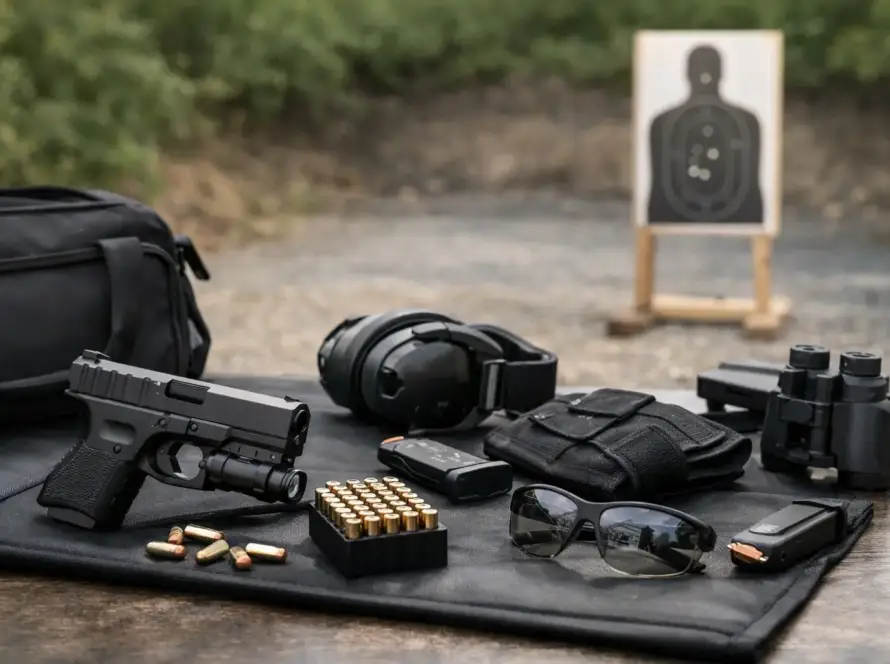
A pistol optic can look perfectly clear on the sales counter and become much less appealing after a few range sessions in heat, rain, lint, and carbon-heavy cleaning. This Holosun EPS review focuses on the factors that matter after mounting: enclosed-emitter protection, usable window size, reticle performance, mounting compatibility, and the compromises that come with an enclosed pistol dot.
The standard Holosun EPS is built for compact and full-size handguns. It gives shooters the environmental protection of an enclosed optic without the oversized profile associated with many earlier enclosed-emitter designs. For defensive pistols, training guns, and hard-use range setups, that is the main reason to consider it.
Holosun EPS Review: What You Get
The EPS uses a 7075 aluminum housing, an enclosed optical system, a side-loading CR1620 battery tray, and an IPX8 water-resistance rating. Depending on the model, buyers can choose a 2 MOA dot, a 6 MOA dot, or Holosun’s Multi-Reticle System with a 2 MOA center dot, 32 MOA circle, or circle-dot combination.
Battery life is rated up to 50,000 hours under specified settings. Solar Failsafe and Shake Awake are standard features that help conserve battery life while keeping the optic ready when the pistol is moved. The controls are straightforward, with side buttons for brightness adjustment and reticle selection on compatible MRS versions.
For shoppers comparing product listings, verify the exact SKU before buying. Reticle color, reticle type, and included accessories differ between EPS models. A green reticle is not automatically better than red, but many shooters find green easier to pick up in bright conditions. The right answer comes down to your eyesight, background conditions, and personal preference.
The Enclosed Emitter Is the EPS Advantage
An open-emitter reflex sight projects its reticle from an exposed emitter. That design is compact and proven, but mud, rain, clothing fibers, oil, or debris can obstruct the emitter and distort or remove the dot. The EPS places that system inside a closed housing with front and rear glass.
That does not make the optic maintenance-free. Both lenses can still collect dust, fingerprints, water spots, and cleaning residue. The practical difference is that an obstruction on an exterior lens is usually easier to recognize and wipe away than an obstructed emitter inside an open design.
This is especially relevant for a pistol carried close to the body, used outdoors, or stored in a vehicle or range bag. Shooters who primarily fire indoors on clean range days may see less benefit, but the enclosed design remains a meaningful insurance policy for a defensive handgun. It also simplifies post-range inspection: check the lenses, verify the dot, and confirm mounting screws remain properly secured.
Window Quality and Sight Picture
The EPS has a generous sight picture for its compact enclosed format. The window is not as large as a competition-oriented open reflex sight, so shooters moving from a large-window optic will notice the tighter housing. In return, they get better protection and a profile that works well on many service-size and compact slides.
The glass is clear, and the aspheric lens helps keep distortion low across the viewing area. At the range, that translates to a predictable dot presentation when your grip and draw are consistent. The optic will not correct poor index or inconsistent presentation, however. New red-dot users should expect a training period before they stop searching for the dot on presentation.
Backup iron sights remain worthwhile on a defensive setup. Select sight heights that allow an appropriate co-witness without cluttering the window, then confirm your sight picture after installation. The best arrangement depends on your slide cut, mounting plate, and preferred irons.
Reticles and Brightness Settings
The 2 MOA dot is the most flexible option for shooters who want precise zeroing and less target coverage at distance. A 6 MOA dot is faster to find for many users and can be an excellent choice for close-range defensive or training use. Neither is universally superior.
The MRS circle-dot option gives the EPS its broadest operating range. The 32 MOA circle can be quick to acquire at close distances, while the center dot allows more refined aiming when needed. It is a useful feature, but it also costs more than a basic single-dot model. If you know you will leave the sight set to one reticle, a standard dot version may be the better value.
Brightness should be checked in the conditions where you actually shoot or carry. A dot that looks ideal under indoor lights can bloom against a bright outdoor target, while a setting that works in midday sun can be too intense in low light. Set it deliberately rather than treating the highest setting as the default.
Mounting the Holosun EPS Correctly
The EPS uses Holosun’s K-series mounting interface. It is closely related to the RMSc pattern, but the recoil-lug arrangement and slide dimensions can affect direct-mount compatibility. Many pistols need the correct adapter plate, and some factory optics-ready slides need minor plate or lug considerations before the sight can mount correctly.
Holosun includes an RMR-to-K adapter plate with the EPS, which is useful for certain optics-ready slides. That does not mean every RMR-cut slide is ready for direct installation with the included hardware. Check your pistol manufacturer’s optics-cut specifications and the plate manufacturer’s instructions before ordering.
Use the correct screw length for your slide and plate combination. Screws that are too long can interfere with internal components, while screws that are too short may not provide adequate engagement. Degrease threaded holes and screws, apply threadlocker only as directed by the manufacturer, torque to the specified value, and allow the threadlocker to cure before live fire.
After installation, zero the optic with the ammunition you intend to use most often. Confirm the zero from a stable position, then validate it with practical drills. A careful mount and a confirmed zero matter more than chasing minor adjustment differences between otherwise capable optics.
Trade-Offs to Consider Before Buying
The EPS is not the smallest enclosed optic Holosun makes. Shooters building a slimline concealed-carry pistol should look closely at the EPS Carry, which has a narrower body designed around slimmer slides. The standard EPS can be an excellent choice on a compact pistol, but its width may be less appealing on very narrow handguns.
It is also more expensive than many open-emitter micro dots. That price increase buys a protected emitter, strong housing material, useful battery features, and solid optical performance. Whether it is worth the premium depends on the role of the pistol. For a casual range gun kept in controlled conditions, an open-emitter sight may deliver everything needed for less. For a daily-carry or outdoor-use handgun, the EPS earns its cost more easily.
The enclosed housing adds a little visual structure around the window. Some shooters prefer the open feel of a larger open-emitter sight, particularly for competition. Others value the protected system enough that the narrower visual frame is a nonissue. Handle both styles when possible, but make the final decision around intended use rather than counter impressions alone.
Who Should Buy the EPS?
The Holosun EPS makes the most sense for shooters who want an enclosed pistol dot on a compact or full-size handgun without stepping into a large, duty-size enclosed optic. It is well suited to responsibly equipped carry pistols, home-defense handguns, range guns exposed to weather, and training setups where reliability and battery management matter.
It is a particularly practical fit for buyers who already have an optics-ready pistol with confirmed K-series or compatible plate support. Before purchase, verify the slide cut, plate, screw requirements, reticle preference, and whether the standard EPS or narrower EPS Carry better matches the handgun.
A quality optic is only one part of a dependable pistol setup. Pair the EPS with a proper mount, a confirmed zero, safe storage, regular lens and battery checks, and meaningful range practice. Buy the version that fits your pistol and intended use, then put the time into presenting it consistently and using it responsibly.