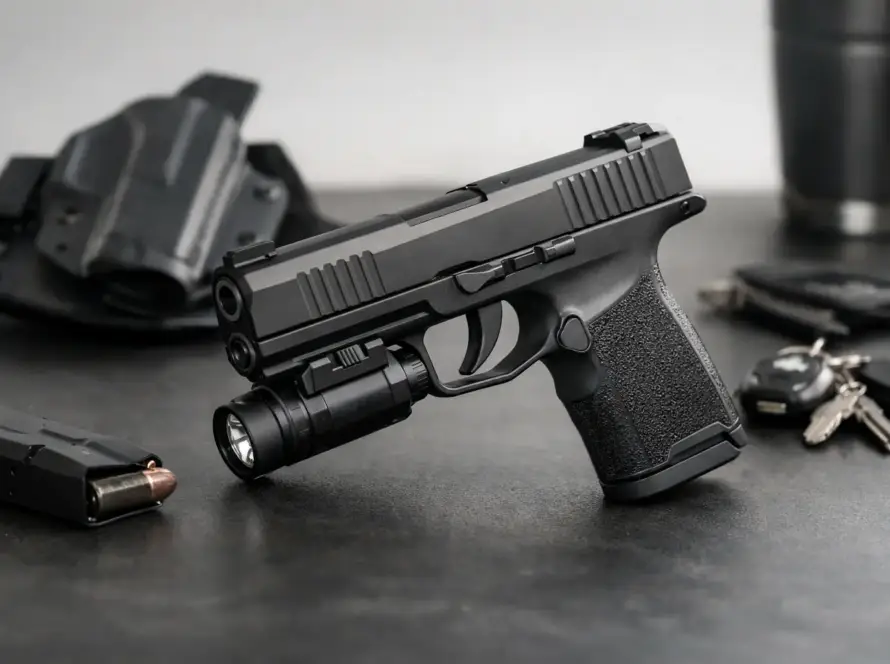
A carry light has to earn its place. It adds bulk at the muzzle, changes holster requirements, and becomes one more control to manage under stress. The best handgun lights for carry are not necessarily the brightest or largest models on the shelf. They are the lights that fit your handgun correctly, ride securely in a quality holster, and remain simple enough to use safely after real training.
For a defensive handgun, identifying a potential threat before making any decision is non-negotiable. A weapon-mounted light can support that task, but it does not replace safe gun handling, a handheld light, sound judgment, or professional training. Choose equipment for the role, then verify it at the range before it becomes part of your daily setup.
What Makes a Handgun Light Good for Carry?
The first requirement is fit. A light must mount securely to the pistol’s rail or use the manufacturer-specific attachment system intended for that firearm. A compact pistol with a short rail may need a dedicated compact model, while many micro-compact pistols require a proprietary light. Forcing an incompatible key, clamp, or adapter is a poor substitute for correct fit.
Holster compatibility comes next. Once a light is mounted, the handgun needs a holster molded for that exact firearm-and-light combination. A generic holster can allow movement, interfere with a clean draw, or fail to retain the pistol properly. Confirm compatibility before buying the light, especially with less common pistols, rail configurations, compensators, or optic setups.
Output matters, but raw lumen numbers do not tell the full story. Candela measures the intensity of the beam in a specific direction, while lumens measure total light output. For carry, a balanced beam that provides usable spill at close distances and enough center intensity to work outdoors is generally more useful than a narrow, long-range beam designed for a full-size duty pistol.
Size and control layout are equally practical concerns. The switches should be reachable without compromising your firing grip, but not so exposed that the light is easily activated in the holster. A low-profile light that matches the dimensions of a compact carry pistol is often the better everyday choice than a larger unit with maximum output.
Best Handgun Lights for Carry by Pistol Size
Compact and Mid-Size Pistols: Streamlight TLR-7 Series
The Streamlight TLR-7 family remains a practical choice for many compact carry pistols. Its compact profile, commonly available holster support, and accessible rear switch design make it a frequent match for popular platforms. Variants within the family are built around different rail lengths and handgun profiles, so the model designation matters.
The TLR-7 Sub is designed for specific subcompact and slimline pistols, using model-specific mounting arrangements. The standard TLR-7 and newer high-output variants better suit many compact rail-equipped pistols. Before ordering, verify the exact pistol generation and rail setup against the light manufacturer’s fit information and the holster maker’s listing.
For the carrier who wants a widely supported option without adding full-size weight, this category is difficult to ignore. Battery access and runtime should still be part of the decision, particularly if the pistol is carried frequently and practiced with often.
Slim and Micro-Compact Pistols: SureFire XSC
For certain micro-compact handguns, the SureFire XSC is purpose-built around the smaller pistol format. Its rechargeable battery system and close-fitting design help it make sense where a conventional rail light would be oversized or simply incompatible. It is a strong option when minimizing added length and width is the priority.
The trade-off is platform specificity. The XSC is not a universal light that moves freely from pistol to pistol. That can be a benefit when the dedicated fit is exactly what your carry gun needs, but buyers should treat the firearm model and light model as a matched set. Check holster availability before committing to the setup.
Value-Focused Carry Setups: Holosun PID K
The Holosun PID K is worth considering for shooters who want a compact weapon light with a modern form factor and straightforward controls. It is positioned for carry-sized handguns and can offer a practical balance between performance, dimensions, and cost.
Its real value depends on the holster ecosystem for your exact pistol. A light can look ideal on the counter and still be the wrong purchase if quality holster options are limited. For a concealed-carry setup, holster access is not an afterthought. It is part of the light selection.
Full-Size Pistols Carried in a Belt Holster: SureFire X300 and Streamlight TLR-1
A full-size light such as the SureFire X300 or Streamlight TLR-1 family is often best suited to duty-size pistols, home-defense handguns, and belt-carried setups where concealment is less restrictive. These models have broad adoption, durable construction, and substantial holster availability.
They can work for concealed carry, particularly with a full-size pistol, a sturdy belt, and an outside-the-waistband or substantial inside-the-waistband holster. Still, their added length and weight are noticeable. For most compact concealed-carry pistols, a shorter light is more comfortable and easier to conceal.
Do Not Buy a Light Before Checking These Details
A reliable carry-light purchase starts with exact model verification. “Fits Glock,” “fits SIG,” or “fits 1913 rail” is not specific enough. Rail geometry, trigger guard shape, slide length, and the location of cross slots can all affect fit.
Check these four details before adding a handgun light to your cart:
- The exact handgun make, model, generation, and rail configuration.
- The exact light model, including its mounting key or dedicated adapter.
- A holster made for that firearm, light, and carry position combination.
- The battery type, charging method, and availability of replacement batteries.
This process avoids the most common frustration: purchasing a light that technically attaches to the gun but has no suitable holster or does not sit correctly on the rail.
Battery Choice and Maintenance Matter
Rechargeable and disposable-battery lights both have a place. Rechargeable systems reduce ongoing battery purchases and can be convenient for frequent range use. The limitation is that you need a charging routine and, in some cases, a spare charged battery. If the battery is proprietary, keep a backup if the light serves a serious defensive role.
Disposable lithium batteries are widely available and easy to replace, which appeals to many users who want predictable field service. Whichever system you choose, do not wait for a low-output beam to remind you about maintenance. Set a schedule to inspect the lens, mounting hardware, switches, and battery condition.
Lens carbon buildup is normal on many pistols because the light sits near the muzzle. Clean it according to the light manufacturer’s instructions. Avoid improvised chemicals or excessive scraping that can damage lens coatings, seals, or the housing.
Train With the Light and Carry a Handheld Too
Mounting a light is not the same as knowing how to use one. Practice activating it with an unloaded firearm in a safe direction, then confirm that you can reach the switch without shifting your grip excessively. Live-fire practice should include safe activation, recoil management, reloads, and holster work when conducted on a range that permits it.
A handheld flashlight remains useful even when a pistol has a mounted light. Most everyday low-light tasks do not call for drawing a firearm. A handheld light lets you check a dark parking area, locate dropped items, or investigate a noise without pointing a loaded gun at something that has not been identified.
For responsible carry, the right choice is usually the light that matches your pistol, your holster, and your willingness to train. Buy for proven fit and dependable operation first. Then build the habits that let the equipment serve its intended purpose safely.