A first handgun purchase should start with the job you need it to do, not a brand logo or a counter recommendation. This beginner handgun buying guide focuses on the factors that affect safe ownership, reliable use, and long-term value: intended use, fit, caliber, capacity, training, and the legal purchase process.
A handgun is not a one-size-fits-all tool. The compact pistol that carries comfortably may be harder to shoot well than a larger range pistol. A revolver can feel straightforward to operate, but usually offers lower capacity and slower reloading. Make the trade-offs before you spend money, then buy the firearm and support gear that fit your actual plan.
Start With the Handgun’s Primary Job
Most first-time buyers are choosing between home defense, concealed carry, range training, or a combination of those roles. Be honest about which one will get the most use. A handgun kept for home defense can be larger, heavier, and easier to control. A handgun intended for daily carry must be compact enough that you will actually carry it in a quality holster.
For range use and general training, a full-size or compact 9mm semi-automatic pistol is often a practical starting point. The added grip length and weight usually make recoil management easier, while 9mm ammunition is widely available and suitable for frequent practice. For a dedicated carry gun, a compact or subcompact model may be appropriate, but smaller guns demand more attention to grip, trigger control, and recoil.
Do not buy one handgun expecting it to be perfect at every task. Many experienced owners eventually keep a larger pistol for training or home use and a smaller model for carry. Your first purchase should simply cover your highest-priority role safely and reliably.
Choose a Platform You Can Operate Confidently
Semi-automatic pistols and revolvers are the two primary handgun platforms. Neither is automatically better for every new buyer.
Semi-automatic pistols generally provide higher magazine capacity, faster reloads, and broad options in size, caliber, and accessories. Most common models use a detachable magazine and a slide that cycles with each shot. New owners need to learn how to load, unload, lock the slide open, clear common stoppages, and inspect the chamber properly. That training is not optional.
Revolvers use a rotating cylinder and are often praised for their simple manual operation. They can be a sound option for buyers who prefer a visible chamber layout and do not want to manage a slide or magazines. The trade-off is typically lower capacity, heavier trigger pulls in double-action operation, more felt recoil in lightweight models, and less efficient reloading.
Handle both platforms at a reputable dealer and, when possible, rent them at a range. A firearm that feels controllable, balanced, and easy to operate under supervision is a better prospect than one chosen solely because it is popular online.
Caliber: Start With What You Can Practice With
For many first-time handgun buyers, 9mm is the practical baseline. It offers manageable recoil in appropriately sized pistols, common availability, a wide selection of reliable defensive ammunition, and a lower practice cost than many larger centerfire calibers. Those factors matter because skill comes from regular, safe range time.
Other calibers may suit specific preferences. .380 ACP can be easier to manage in some designs, though very small pistols may still feel sharp in the hand. .38 Special is common in revolvers and can be a manageable option, particularly in a steel-frame revolver. .40 S&W and .45 ACP have established followings, but they often bring more recoil and higher ammunition costs. For most beginners, those trade-offs do not create a clear advantage.
Do not select a caliber based on internet arguments. Choose one you can control, afford to practice with, and buy consistently from reputable manufacturers. A full-size 9mm you train with is generally a more useful first purchase than a harder-kicking handgun that stays in the safe.
Fit Matters More Than First Buyers Expect
A handgun should sit securely in your hand without forcing you to shift your grip to reach the trigger, magazine release, slide stop, or cylinder latch. With an unloaded firearm and dealer guidance, establish a normal firing grip. Your trigger finger should reach the trigger naturally, and you should be able to maintain a firm hold without excessive strain.
Grip texture matters as well. Aggressive texturing can aid control but may be uncomfortable for concealed carry against bare skin. A thin grip may fit smaller hands but feel less stable during recoil. Interchangeable backstraps, common on many modern striker-fired pistols, can help tailor the grip to the shooter.
Weight is another trade-off. A lighter handgun is easier to carry, but it usually transfers more recoil to the shooter. A heavier handgun can be more comfortable and controllable at the range, but less convenient to carry. There is no universal right answer. Shoot comparable sizes before making a final decision if you can.
Sights, Controls, and Trigger Systems
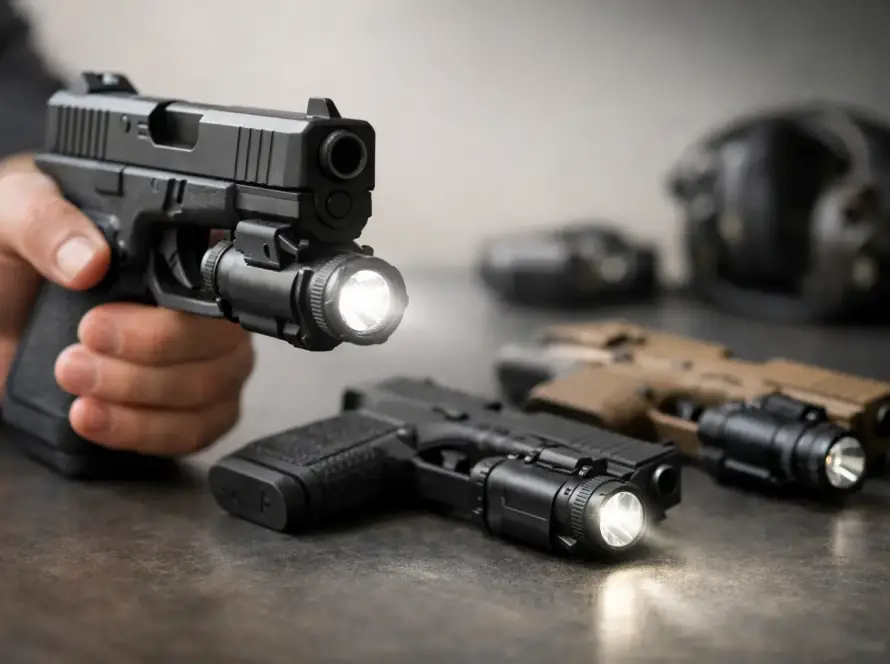
Keep the first setup simple. Standard iron sights are sufficient for learning safe handling, sight alignment, and trigger control. Factory night sights can be useful in low light, but they do not replace a handheld light, secure storage, or training. Optics-ready pistols are increasingly common, yet a red-dot sight adds cost, mounting considerations, batteries, and another system to maintain.
Pay attention to the controls you must use safely: the magazine release, slide stop, takedown lever, and any manual safety or decocker. A manual safety is a personal preference, not a substitute for safe gun handling. If you choose one, train until operating it is consistent and deliberate.
Trigger feel also varies by platform. Striker-fired pistols often have a consistent trigger press from shot to shot. Hammer-fired pistols may use double-action/single-action or single-action-only systems that require different handling and training. Avoid trying to diagnose a trigger by dry handling alone. A qualified instructor and live-fire rental session will tell you far more about what you can shoot safely and accurately.
Build the Real Purchase Budget
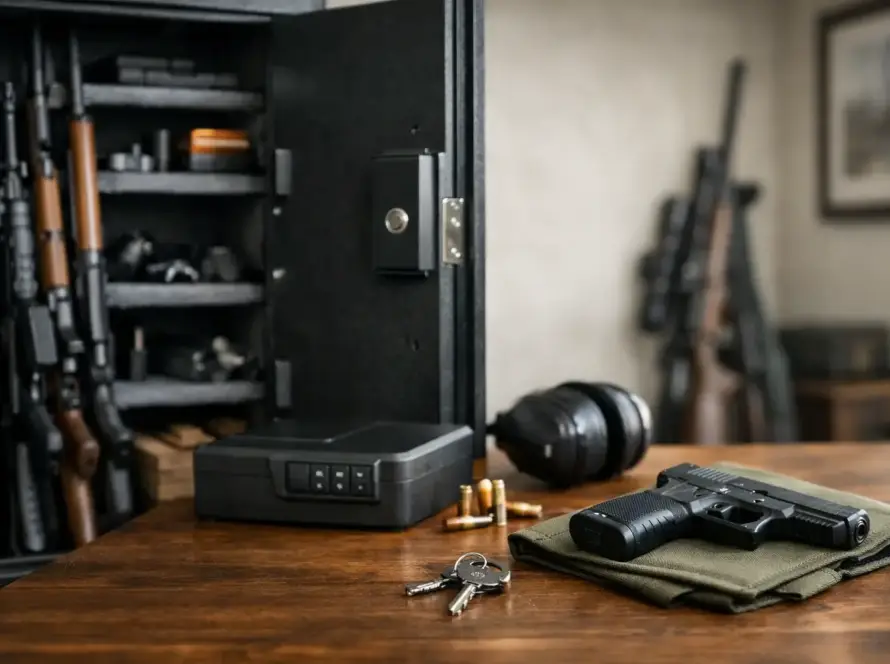
The handgun is only one part of the purchase. Set aside money for the equipment and training that make ownership responsible. A bare firearm without secure storage, eye and ear protection, practice ammunition, cleaning supplies, and a range plan is an incomplete setup.
Plan for these essential items:
- A locking safe, lockbox, or other secure storage that prevents unauthorized access
- Eye and ear protection rated for range use
- Quality practice ammunition from a reputable manufacturer
- At least one professional beginner handgun or safety course
- A suitable holster if the firearm will be carried, plus a rigid belt if needed
For a carry handgun, do not cut corners on the holster. It should cover the trigger guard completely, retain the firearm securely, hold its shape during reholstering, and fit the specific handgun model. Loose universal holsters, improvised pockets, and purse carry without a dedicated secured compartment create unnecessary risk.
Know the Legal Process Before You Order
Firearm laws vary by state and local jurisdiction. Federal law also applies to dealer transfers and background checks. Before placing an order, confirm that the model, magazine capacity, and any included features are legal where you live. Make sure you understand the transfer process, the requirements of the receiving Federal Firearms Licensee, and any state permits, waiting periods, registration rules, or storage requirements that may apply.
A legitimate retailer will ship a firearm to a licensed dealer for transfer, not directly to your home. Contact the receiving dealer before ordering to confirm transfer fees, accepted shipments, identification requirements, and any local procedures. This prevents delays and helps you avoid ordering equipment that cannot be transferred legally.
If you are considering concealed carry, review your state’s current carry laws before you carry. Permit rules, prohibited locations, vehicle rules, duty-to-inform requirements, and reciprocity can change. Training should cover legal responsibilities along with firearm handling.
Test Before You Commit When Possible
A range rental is one of the best ways to avoid an expensive mismatch. Try several handguns in the same general category, such as a full-size 9mm, compact 9mm, and a revolver. Focus on practical questions: Can you load and unload it safely? Can you reach the controls? Does the grip stay stable during firing? Can you make controlled, accurate shots without discomfort?
Do not judge a handgun after one magazine. Shoot enough to notice fatigue, recoil recovery, and whether your grip shifts. Ask a qualified range instructor to watch your grip and operation. What feels awkward may be a poor fit, or it may be a correctable technique issue. Either way, you will leave with better information.
Buy for Training, Not for a Display Case
The best first handgun is the one you can store securely, operate safely, shoot accurately, and practice with regularly. Proven models from established manufacturers are usually the smart place to start because magazines, holsters, replacement parts, and training resources are easier to find. Guns & Tactics can help buyers compare handgun categories and the supporting gear needed to get range-ready.
Once you make the purchase, schedule training and establish a storage routine before the handgun becomes part of your daily life. Competence is built through safe repetition, not through owning more gear. Start with a handgun that fits your mission and your hands, then put the time behind it.